
What Does CIP Stand For? Clean-in-Place Explained in Plain Terms
CIP stands for Clean-in-Place. It is a method of cleaning the inside of tanks, pipes, pumps, valves, and fittings with automated flows of water and cleaning solutions, without taking the equipment apart. In food, beverage, pharma, and biotech plants, “CIP” almost always means this.
TL;DR
- CIP stands for Clean-in-Place: cleaning product-contact surfaces by circulating solutions through the equipment while it stays assembled.
- A CIP cycle may include a rinse, a caustic wash, another rinse, an acid wash and a final rinse.
- Four main variables set how well a cycle cleans: flow, temperature, chemistry, and contact time.
- Equipment has to be built for CIP. Drainable geometry, smooth finishes, and compatible seals decide whether a component survives the cycle.
- Ask about CIP compatibility before a purchase order goes out.
Defined Term: Clean-in-Place (CIP)
An automated cleaning method that circulates water and cleaning solutions through process equipment and piping while the equipment stays assembled.
Plenty of engineers and QA staff hear “CIP” in a vendor meeting and nod along. The risk shows up after the purchase: a gasket that swells in the caustic wash, a valve with a pocket that never drains, or a pump that has to be pulled apart between batches. Knowing what CIP asks of a component takes a few minutes and saves that conversation later.
What does CIP stand for in sanitary process equipment?
In process plants, CIP stands for Clean-in-Place. The term describes a cleaning method, and it applies to the whole system: tanks, piping, pumps, valves, and fitting the product touches.
The alternative is manual cleaning, often called clean-out-of-place (COP). A technician takes the equipment apart, scrubs the parts, and puts them back together. That method takes more labor and more downtime, and results vary from one technician to the next. CIP replaces most of that work with a programmed cycle that runs the same way every time.
Defined Term: Clean-out-of-Place (COP)
Cleaning equipment after it has been taken apart, usually by hand or in a wash station.
How does a CIP cycle work?
A typical CIP cycle has five steps, and a controller/PLC runs them in sequence. The exact recipe depends on the product, the equipment, and the plant’s validated procedure.
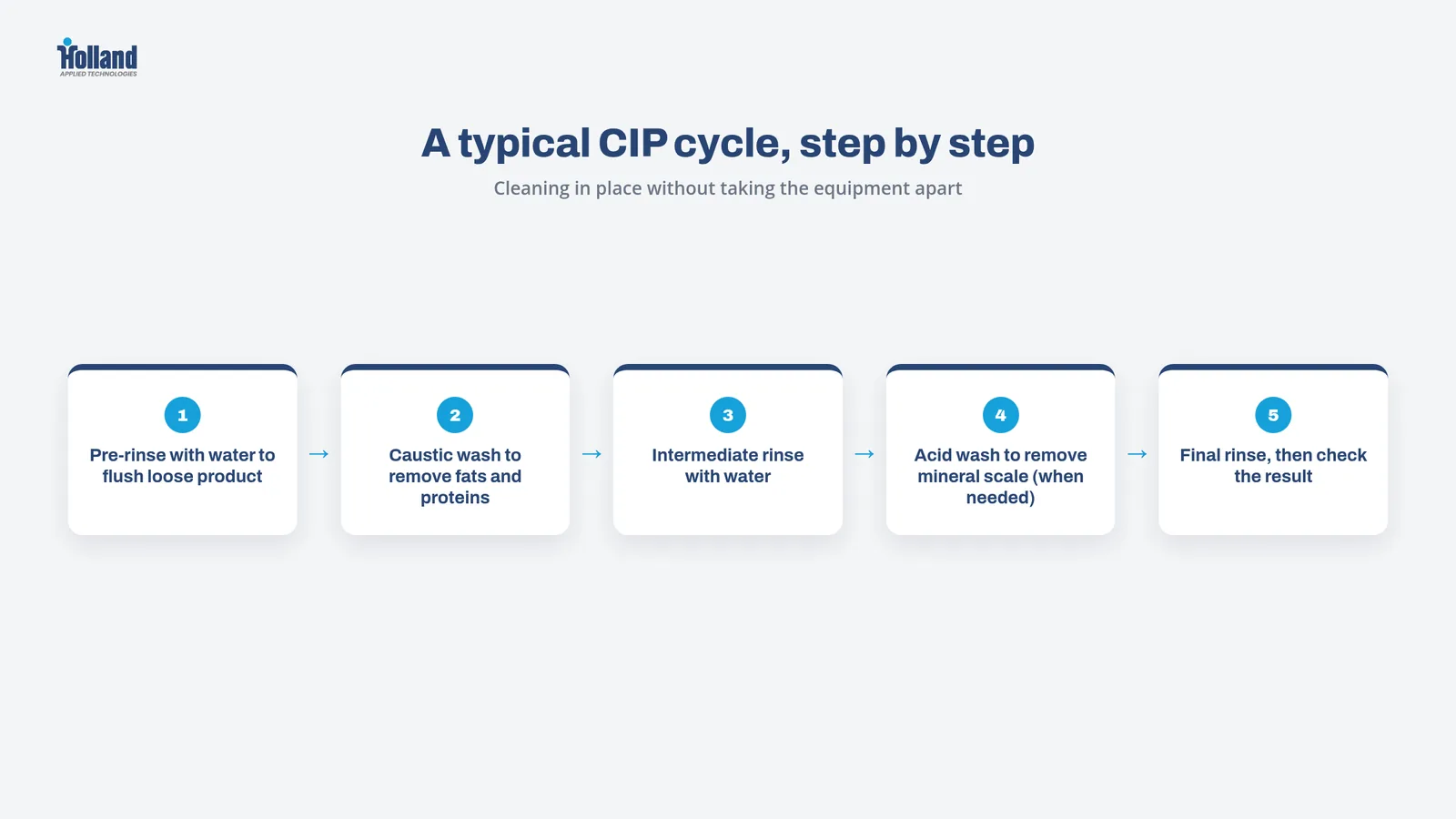
- Pre-rinse. Water flushes out loose product and residue.
- Caustic wash. A hot alkaline solution breaks down fats, proteins, and other organic soil.
- Intermediate rinse. Water pushes the caustic out of the system.
- Acid wash. An acid solution removes mineral scale and film. Many cycles skip this step when scale is not a problem.
- Final rinse. Clean water flushes the last of the chemistry. Many plants then check the rinse water before the line returns to production.
Some lines add a sanitizing step at the end. Steam-based sterilization is a separate process called SIP, and the CIP vs SIP guide covers how the two fit together.
What makes a CIP cycle clean well?
Four variables control cleaning: flow, temperature, chemistry, and time. If one drops, the others have to make up for it, and a surface that sees too little of any of them stays dirty.
- Flow. Fluid moving fast enough to scrub the wall of the pipe removes soil that still water leaves behind. Plants set a minimum velocity for their piping.
- Temperature. Warmer solutions clean faster, up to the limit of what the chemical equipment and its elastomers can take.
- Chemistry. The cleaner has to match the soil. Alkaline solutions handle organic residue, and acids handle mineral deposits.
- Contact time. Each step has to run long enough for the solution to work.
Each variable also loads the equipment. Hot caustic at high velocity, repeated every batch or every day, is hard on seals, gaskets, and surfaces. That is why CIP compatibility belongs in the buying decision.
What does CIP require of the equipment?
A component has to let the solution reach every product-contact surface and then drain completely. Four requirements come up on nearly every spec review.
| Requirement | What to check |
|---|---|
| Drainable design | No pockets, dead legs, or low points where liquid sits after the cycle |
| Surface finish | A smooth, measured finish on product-contact surfaces so soil has nothing to grip |
| Seal and gasket materials | Elastomers rated for your caustic and acid chemistry at your cycle temperature |
| Material compatibility | Wetted metals that hold up to the cleaning chemistry over repeated cycles |
These requirements connect to other parts of a spec. Surface finish is measured as Ra, and gasket elastomer choice depends on the chemistry in your wash.
Defined Term: Dead leg
A section of pipe, fitting, or equipment where liquid can sit without flowing/draining, so cleaning solution may never reach it and product residue can collect.
What should you ask a vendor about CIP compatibility?
Ask for written answers to these questions before you order. A supplier who sells sanitary equipment should be able to answer them.
- Can this component be cleaned in place without disassembly?
- Which cleaning chemistries and temperatures are the seals and gaskets rated for?
- Does the design drain fully when installed in my orientation?
- What is the measured surface finish on product-contact surfaces?
- Does the component need to be removed for periodic inspection or seal replacement?
Question 5 catches a common surprise. A component can tolerate CIP chemistry and still need to come out of the line on a schedule. Plan for that in the layout and the maintenance calendar.
Does CIP mean something else?
Yes. The same three letters mean different things in other fields, which is why a general web search for the acronym returns mixed results.
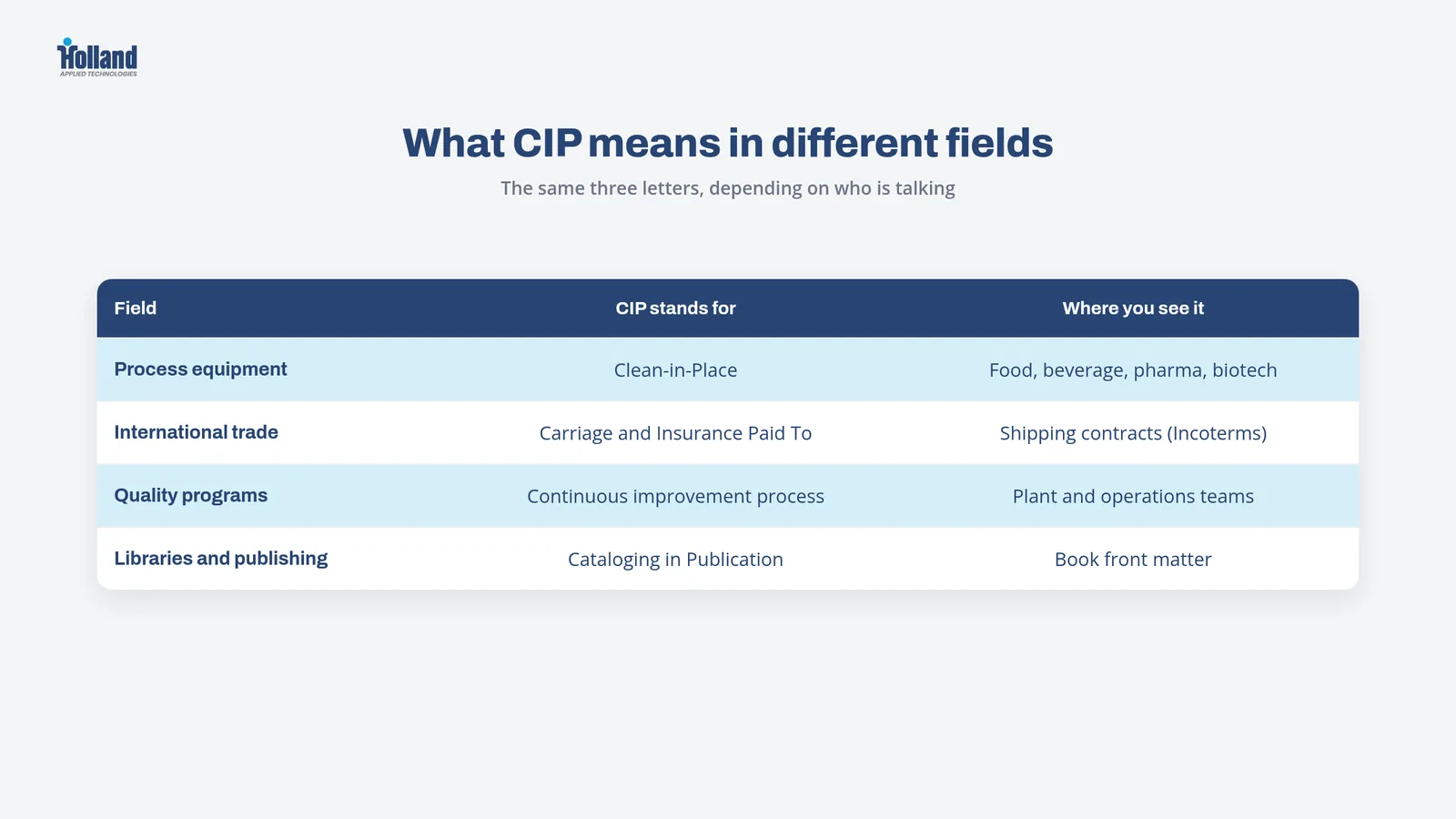
In international shipping, CIP is the Incoterm Carriage and Insurance Paid To. In operations and quality work, it can mean continuous improvement process. In publishing, it stands for Cataloging in Publication. Context settles it. In a conversation about tanks, pumps, valves, and cleaning, CIP means Clean-in-Place.
Ask about CIP before you buy
CIP stands for Clean-in-Place, and every component in a CIP system has to drain, resist the wash chemistry, and clean without disassembly. Check drainability, surface finish, and seal compatibility in writing before the purchase order goes out.
Ready to solve this?
Send over your system details and Holland’s engineers will help you specify the right cleaning approach and confirm CIP compatibility for each component.
Author
Holland Applied Technologies’ engineering team works daily with process and manufacturing engineers across pharma, biotech, and food and beverage manufacturing, specifying and supporting the sanitary and high-purity process equipment their lines depend on.