

Sanitary Valve FAQs: Butterfly, Ball, and Diaphragm Valves Answered
Across butterfly, ball, and diaphragm valves, the purchase price tells you the least about lifetime cost. Diaphragms and seats are the wear parts that drive maintenance, teardown frequency follows actuation count and cleaning chemistry, and lifespan is measured in cycles and calendar months from your own inspection records.
Most engineers who read a valve comparison come away with a valve type and a purchase price. The budget questions arrive later: how often the valve gets torn down, what the replacement parts cost, how long they last, and what usually fails first. Many buyers assume all three types carry roughly the same maintenance and cost profile, and the surprise shows up as teardown hours and elastomer replacements that were never in the original budget.
This article answers those questions for butterfly, ball, and diaphragm valves. It assumes you have read the Sanitary Valve Comparison and does not repeat the basics of how each type works.
TL;DR
- Purchase price ranks butterfly lowest, ball in the middle, and diaphragm highest, and that ranking often reverses when wear parts, labor, and downtime are added.
- Each type has one primary wear part: the butterfly seat, the ball valve seats and stem seals, and the diaphragm.
- Teardown frequency follows actuation count, temperature, product, and cleaning chemistry, so set intervals from your own records.
- Failure points differ by type, and a short inspection checklist catches most of them before a leak.
- A per-valve maintenance budget has five lines: wear parts, labor, downtime, actuator service, and spares.
How do the three sanitary valve types compare on purchase cost?
Butterfly valves cost least to buy, ball valves sit in the middle, and diaphragm valves cost the most at comparable sizes. The gap shifts with size, end connections, materials, and actuation, so treat the ranking as a general guide.
Three factors push the ranking around:
- Size: the price gap between types widens as line size grows.
- Materials and finish: electropolished interiors, special seat compounds, and certified materials add cost to every type.
- Actuation: an actuated valve with position feedback can cost more than the valve body itself on a small line.
A purchase price comparison answers only the first line of the budget. The next questions cover everything that follows it.
What costs sit outside the purchase price of a sanitary valve?
Six lines sit outside the purchase price: wear parts, elastomer seals, teardown labor, line downtime, actuator service, and spares. Together they often exceed the original price over a valve’s service life on high-duty service points.
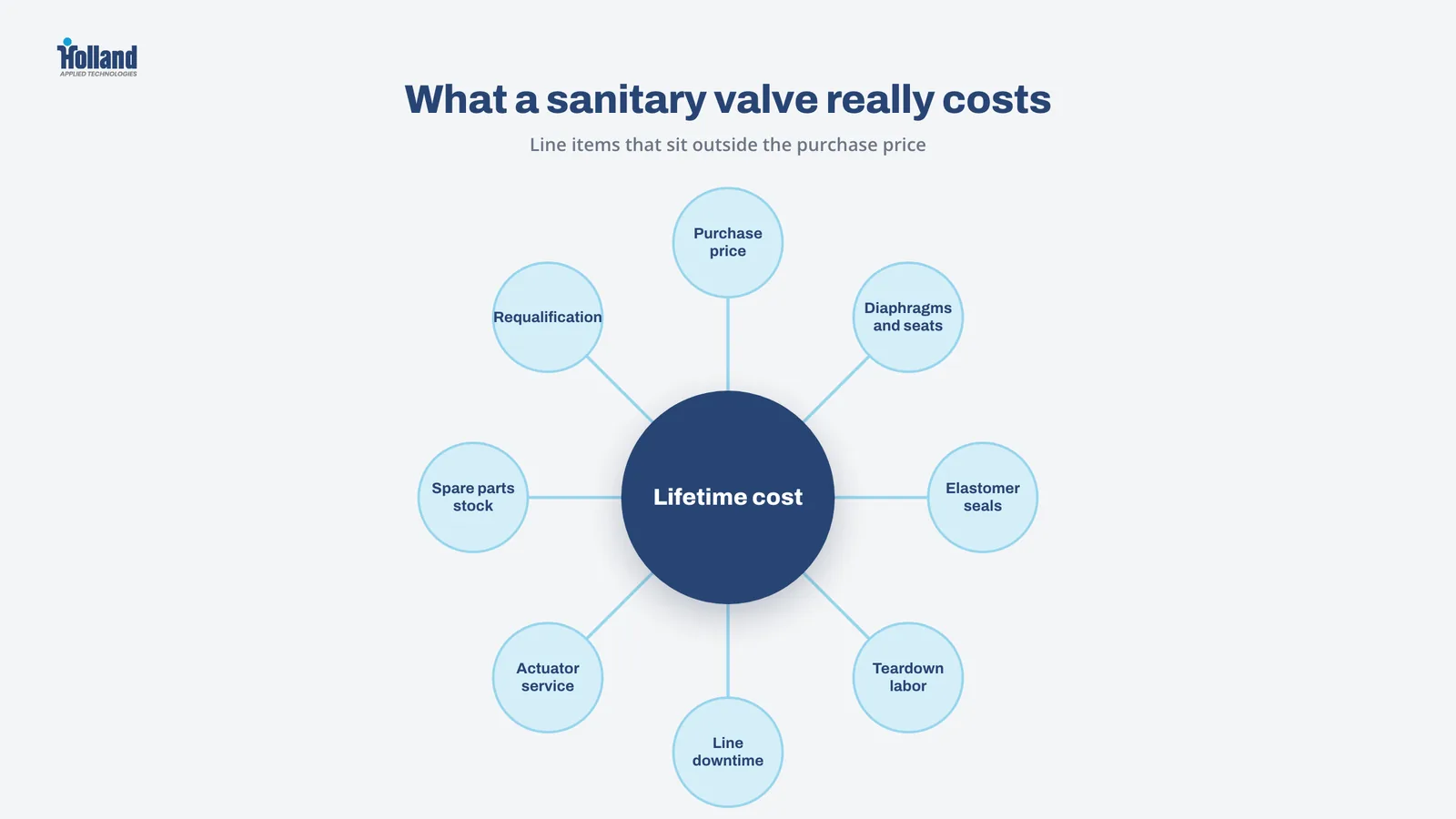
Each line behaves differently by valve type:
- Wear parts: butterfly valves wear the seat, ball valves wear the seats and stem seals, and diaphragm valves wear the diaphragm.
- Elastomer seals: body gaskets, stem seals, and bonnet seals all sit in the product or cleaning path and age with temperature and chemistry.
- Teardown labor: time to isolate, drain, open, inspect, rebuild, and return the valve to service.
- Line downtime: the production time lost while the valve is open. A planned teardown in a scheduled stop costs much less than an emergency one mid-run, and an emergency stop can also carry the price of lost product.
- Actuator service: springs, seals, solenoids, and position sensors.
- Requalification: inspection or validation steps after a rebuild on regulated lines.
Holland’s earlier post on cleaning cycle time and valve choice shows how valve design reaches into cleaning time and production hours, which is where the downtime comes from.
How often does each sanitary valve type need a teardown?
Teardown frequency depends on actuation count, temperature, product, and cleaning chemistry more than on valve type. A butterfly valve on a clean water line can run for long intervals, and the same valve on a hot, fatty product with frequent cycling needs attention far sooner.
A workable starting point is a fixed inspection interval for each valve tag, then an adjustment based on the wear found at each inspection:
- Set a first inspection date for each valve, early enough to catch a bad assumption.
- Open the valve, record the condition of the seat, ball, or diaphragm, and photograph it.
- Lengthen the interval if the part looks fresh, and shorten it if it shows wear.
- Repeat until the interval settles, then tie it to cycle counts where the controller logs them.
Type matters at the margins. Butterfly valves typically have the shortest teardown, since the seat and disc come out of a body with few components. Ball valves take longer, because the ball and seats have to come out. Diaphragm valves split the work: the bonnet comes off for a diaphragm change, and the body can stay in the line.
How long does a sanitary valve diaphragm last?
A diaphragm lasts a number of cycles and a number of months that depend on temperature, steam exposure, product, cleaning chemistry, and how the valve is operated. No single figure applies across plants, so the reliable answer comes from your own inspection records.
Defined Term: Diaphragm
the flexible membrane in a diaphragm valve that seals the product off from the bonnet and presses against the weir or seat to close the valve. It flexes on every cycle and is the primary wear part.
Four conditions shorten diaphragm life:
- High cycle counts: every cycle flexes the material.
- Steam sterilization: repeated SIP cycles stress the diaphragm and the sealing area.
- Hard or sharp particles: these can cut or pit the sealing surface.
- Chemistry mismatch: a material that suits the product can degrade in a hot caustic wash.
Inspect the diaphragm at set intervals and replace it on evidence of wear, such as cracking, thinning, or pinholes near the sealing area. Planned replacement costs far less than a failure in service.
How long do butterfly valve seats last?
A butterfly valve seat lasts as long as cycle count, temperature, product, and cleaning chemistry allow, and the seat compound is the biggest lever you control. The seat is an elastomer ring that the disc compresses on every closing, so it wears with each cycle and ages with each hot wash.
Watch for three signs on inspection: compression set, which leaves the seat flattened and slow to recover; swelling, which signals a chemistry mismatch; and scoring from abrasive product. Any of the three means the seat is near the end of its life.
Match the seat compound to both the product and the cleaning chemistry. Holland’s guides to sanitary gasket elastomer materials and gasket chemical compatibility cover how common compounds respond to typical chemistries.
How long do ball valve seats last?
Ball valve seats last longest on infrequent isolation service with clean product and shorten with frequent cycling, abrasives, and temperature swings. The seats are usually PTFE or a similar polymer, and they seal against the ball on every closing.
Two behaviors drive seat life. Polymer seats can creep under sustained load and temperature, which loosens the seal over time. Abrasive particles score the ball and the seat faces, which opens a leak path.
Stem seals are the second wear item. They sit where the stem passes through the body, and they age with temperature and cleaning chemistry in the same way as other elastomers.
What are the most common failure points on each valve type?
Each type fails in a characteristic place: the diaphragm, the seat, or the seat and stem seal. Knowing the place tells you what to inspect and what to keep in stock.
| Valve type | Common failure point | Typical sign | What to check |
|---|---|---|---|
| Butterfly | Seat compression set or swelling, and stem seal wear | Leakage past the disc when closed, or weeping at the stem | Seat condition, disc scoring, and stem seal |
| Ball | Seat creep or scoring, and stem seal wear | Leakage through the valve when closed, or product at the stem | Seats, ball surface, and cavity cleanliness |
| Diaphragm | Cracking, thinning, or pinholes in the diaphragm; loose bonnet bolts | Product at the bonnet vent or around the bonnet joint | Diaphragm sealing area and bonnet bolt torque |
Each of these has a planned fix. A seat or diaphragm replaced at inspection costs a small part and a short stop. The same part replaced after it leaks costs the part, an unplanned stop, and often a product loss or a cleaning cycle repeat.
What does elastomer replacement cost, and how do you budget for it?
Elastomer replacement cost depends on the compound, the size, and how many seals the valve carries, and you budget it by listing every seal and its expected interval. The part price is usually modest. Labor and downtime carry most of the cost.
Build the elastomer budget in three moves:
- List the seals: seat or diaphragm, body gasket, bonnet seal, stem seal, and actuator seals.
- Assign an interval: use your inspection records, and start from a fixed calendar interval where you have none.
- Price the stop: add the labor and the production time for each planned interval.
Compound selection moves the number more than the part price suggests. A compound that suits your chemistry lasts longer and cuts the number of stops. The cheapest compound in the catalog can be the most expensive on the maintenance schedule.
How do CIP and SIP cycles affect valve lifespan?
Hot caustic, acid washes, and steam sterilization cause aging on seals and diaphragms faster than the product usually does. Every extra hot cycle takes time off the life of the seat, diaphragm, or seal, so a plant that adds cleaning steps shortens the intervals.
Defined Term: SIP (steam-in-place)
a sterilization step that passes steam through process equipment without disassembly. SIP exposes seals and diaphragms to high temperature and repeated thermal cycling.
Three habits protect valve life:
- Match the compound to the hottest step: choose seat and diaphragm material against the SIP or hot CIP step.
- Check bonnet bolt torque after thermal cycles: diaphragm valve bonnet bolts can loosen after thermal cycling.
- Record cleaning changes: when the chemistry, temperature, or cycle count changes, shorten the inspection interval until the new wear pattern is clear.
Which spare parts should you stock for sanitary valves?
Stock the wear part for each valve type you run, plus the seals that come out with it, in a quantity tied to cycle count and the lead time for replacement. A valve without a spare turns a planned teardown into a wait.
A starting list for most plants:
- Butterfly valves: seats and stem seals.
- Ball valves: seat and seal kits.
- Diaphragm valves: diaphragms, bonnet seals, and the fasteners the manufacturer specifies.
- All actuated valves: actuator seal kits and position sensors for the critical tags.
Holland’s post on backup spares for sanitary pumps and valves covers how to decide what to keep on the shelf. Review the list whenever a valve type or elastomer compound changes.
Ready to solve this?
Send over your valve list and cleaning chemistry, and Holland’s engineers will help you build a spares list that matches your service points.
Do actuators and position feedback change valve maintenance?
Actuators and position feedback add their own service items to the maintenance plan, and they matter most on valves that cycle often. Actuated valves carry springs, seals, solenoids, and sensors that wear on their own schedule.
Three points affect the budget. Spring-return actuators carry the fail position, so a failed spring changes the safe state of the line. Air quality and supply affect actuator seal life. Position sensors and control tops sit close to the cleaning environment and take wash-down exposure.
Holland’s product notes on valve communication and control, and control tops for sanitary valves show what feedback and actuator options look like in service. Add the actuator to the maintenance schedule as a separate item with its own interval.
What warning signs show a sanitary valve is failing before it leaks?
Slow or uneven operation, a rise in required actuation force, product at a vent or joint, and failed cleaning verification all signal a failing valve before a visible leak. Catching these early turns an emergency into a planned stop.
Check these on each inspection round:
- Actuation time: a valve that closes more slowly than it did has friction or wear to find.
- Actuation force or air pressure: a rising requirement points to seat creep, swelling, or a dry stem seal.
- Product at a vent, weep hole, or joint: the earliest visible sign of a seal or diaphragm failure.
- Cleaning verification: a swab or ATP result that starts to drift can trace back to a worn seat holding residue.
- Position feedback mismatch: a valve that reports open or closed out of step with the command needs a mechanical check.
Log each finding by valve tag so a pattern shows up across the line.
How does the product change maintenance on each valve type?
Product viscosity, particle content, fat or sugar load, and temperature each change which part wears and how quickly. The same valve type can run for long intervals on one product and need frequent attention on another.
Use this guide to match product to the likely wear pattern:
- Clean, low-viscosity liquids: all three types run long intervals, and the cleaning chemistry sets the schedule.
- Viscous or sticky product: residue builds around seats and the diaphragm sealing area, so inspect for buildup and verify cleaning before looking for wear.
- Product with soft solids: a full-bore ball valve passes them, and the seats see less impact than a disc or diaphragm would.
- Abrasive or hard-particle product: seats and diaphragms score and wear first, and the interval shortens sharply.
- Hot product or hot cleaning: elastomers age faster, and compound selection becomes the main maintenance decision.
When the product changes, review the inspection interval for every valve on that line before the first production run.
How do you build a maintenance budget for each valve?
Build the budget per valve tag with five lines: wear parts, labor, downtime, actuator service, and spares. A per-tag budget shows where the money goes and which valves cost more than their type suggests. Holland Applied Technologies offers On-Site Audits to help you build a maintenance plan/budget. Holland also offers full maintenance repair plans for your facility where we provide labor and parts for preventative maintenance programs during shutdowns.
List every valve with its type and duty
Create one row per valve tag. Record the type, size, product, cleaning chemistry, and actuations per shift. These five fields set the rest of the budget.
Assign the wear part and the interval
For each row, name the wear part and set its first inspection interval. Use cycle counts where you have them and calendar time where you do not.
Price the labor and the stop
Estimate the technician hours and the production time for a planned teardown. Add the cost of an unplanned stop in a second column, so the value of a planned interval is visible.
Add actuator service and spares
Give each actuated valve its own service line. Add the spares you decided to stock, and the cost of holding them.
Review the budget after each inspection
Update the interval and the cost with what the inspection found. After two or three rounds, the budget reflects your line and replaces the assumptions you started with.
Budget the full service life of each valve
Valve cost is the sum of the purchase price, wear parts, labor, downtime, actuator service, and spares across the years the valve runs. Each valve type has a primary wear part and a typical failure point, and each one responds to a planned interval better than to a repair after a leak.
Set an inspection interval for every valve, record what you find, and let the records set the schedule.
Ready to solve this?
Send over your valve list and cleaning chemistry, and Holland’s engineers will help you specify valves with the maintenance profile your line can support.
Author
Holland Applied Technologies’ engineering team works daily with process and manufacturing engineers across pharma, biotech, and food and beverage manufacturing, specifying and supporting the sanitary and high-purity process equipment their lines depend on.
Related posts
- Reduce Cleaning Cycle Time by 80% by Using a Better Valve
- Do You Have Backup Spares for Your Sanitary Pumps and Valves?
- An Overview of Sanitary Gasket Elastomer Materials