
How to Choose a Sanitary Pump for Food Processing
Choosing a sanitary pump for food processing means matching three things at once: your product’s physical properties (viscosity, shear sensitivity, solids content), your process conditions (flow rate, head, CIP/SIP requirements), and a pump technology built to handle that combination. There is no single “best” sanitary pump, only the pump that fits your specific product and process.
TL;DR
- Sanitary pump selection is a matching exercise between your product, your process conditions, and a pump technology family. There is no single pump that is universally correct.
- Profile your product first: viscosity across your actual operating temperature, shear sensitivity, and any solids or particulates in the line.
- Translate your process into numbers: required flow rate and head, suction conditions, and your CIP/SIP cycle requirements.
- Centrifugal pumps handle thin, non-shear-sensitive fluids at high flow. Rotary lobe and twin screw pumps handle viscous, shear-sensitive, or solids-laden product.
- CIP compatibility changes the decision at the seal, the internal geometry, and sometimes the pump technology itself.
- The most common selection mistake is specifying by habit or catalog number, without checking it against your actual product and process data.
Most sanitary pump specs start the same way: someone pulls up the last purchase order, orders the same model number, and moves on. That works until the new application has a different viscosity, a different solids load, or a tighter CIP cycle than the last one, and the pump that “always worked” starts wearing out early, damaging product, or fighting the line every shift.
Specifying by habit or catalog number, without checking it against the actual process in front of you, is the single most common way a sanitary pump selection goes wrong, and it rarely shows up as an obvious failure. It shows up months later as unexplained maintenance costs, product quality variance, or a line that never quite hits its rated throughput.
What determines the right sanitary pump for your application?
Three inputs determine the right sanitary pump: the physical properties of the product itself, the process conditions the pump has to operate under, and the CIP/SIP cleaning requirements it has to survive. Get all three in hand before you look at a single pump model, because a pump correctly sized for flow and head but wrong for your product’s viscosity or shear sensitivity will still fail, just in a different way.
Profile the product. Write down the actual measured viscosity at real operating temperature (a published value for a “similar” product won’t match closely enough to size against), note whether the product is shear-sensitive (does agitation break it down, separate it, or change its texture), and document any solids, particulates, or fibers the pump has to pass without damage.
Translate the process into numbers. Calculate the actual flow rate and head at the pump’s real operating point; the nameplate maximum is the pump’s upper limit and rarely reflects day-to-day operation. Confirm suction conditions and the net positive suction head (NPSH) available at the inlet, and document your CIP/SIP cycle’s temperature, chemistry, and duration.
Once the product profile and process numbers are in hand, they point toward a pump technology family before you look at a specific model.
Defined Term: NPSH (Net Positive Suction Head)
the difference between the pressure at a pump’s suction inlet and the fluid’s vapor pressure at the pumping temperature. If NPSH available falls below what the pump requires, the fluid vaporizes inside the pump (cavitation), damaging it and disrupting flow.
When should you choose centrifugal, rotary lobe, twin screw, or diaphragm?
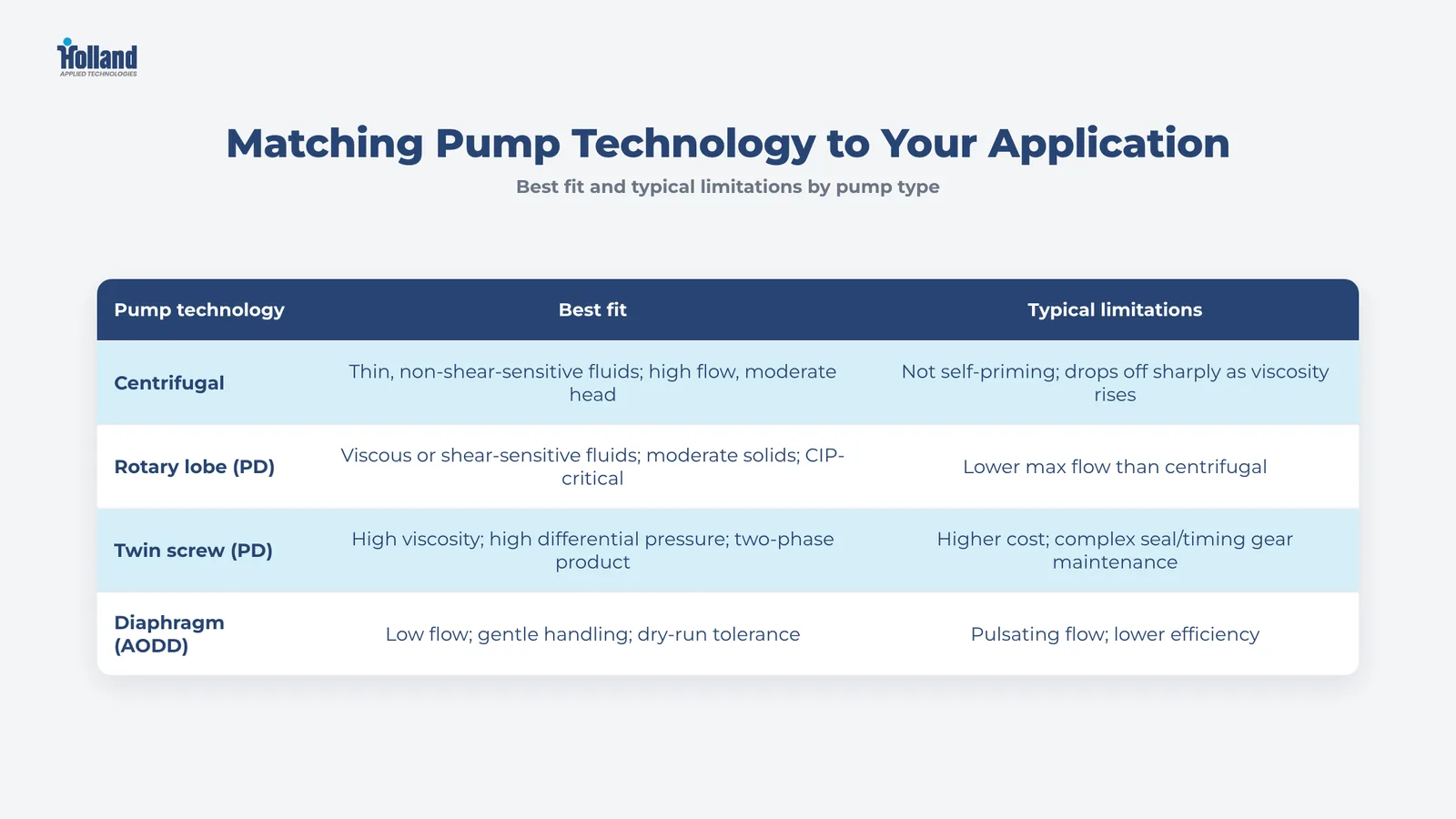
Each pump technology trades off differently across flow capacity, shear sensitivity, solids handling, and pressure capability, which is why the profiling above has to happen before this decision.
Centrifugal fits a product that behaves like water or a light syrup, doesn’t degrade under impeller shear, and needs high flow at moderate head. It’s the most common choice across sanitary processing precisely because so many process fluids fit that description, but the same traits that make it efficient at high flow make it a poor match once viscosity climbs or shear sensitivity enters the picture.
Rotary lobe fits product that’s more viscous than water, shear-sensitive, or carries a moderate solids load, with the added benefit of self-priming operation and easier CIP disassembly for inspection.
Twin screw fits applications where viscosity or required differential pressure exceeds what a rotary lobe pump handles efficiently, or where entrained air or a two-phase mixture would cause a rotary lobe or centrifugal pump to lose consistent flow. It costs more and carries more complex maintenance, so it typically gets specified only when the application genuinely exceeds rotary lobe capability.
Diaphragm (AODD) fits low-flow applications needing genuinely gentle handling or the ability to run dry during batch transitions, trading pumping efficiency and flow consistency for that flexibility.
| Pump technology | Best fit | Typical limitations |
|---|---|---|
| Centrifugal | Thin, non-shear-sensitive fluids; high flow, moderate head | Generates shear at the impeller; not self-priming; performance drops sharply as viscosity rises |
| Rotary lobe (PD) | Viscous or shear-sensitive fluids; moderate solids; CIP-critical applications | Lower maximum flow than centrifugal; more moving parts to maintain |
| Twin screw (PD) | High viscosity; high differential pressure; two-phase or aerated product | Higher unit cost; more complex seal and timing gear maintenance |
| Diaphragm (AODD) | Low flow; gentle handling; dry-run and abrasive-solids tolerance | Pulsating flow; lower efficiency; air supply required |
Where does CIP compatibility change the pump decision?
CIP compatibility changes the decision at the seal (which has to survive repeated exposure to your specific chemistry without degrading), the internal geometry (which has to eliminate dead legs and hard-to-reach corners), and sometimes the pump technology itself, since a design that otherwise fits the product on paper may not achieve full CIP validation for a given chemistry and cycle.
A rotary lobe pump’s relatively open internal geometry typically CIP cleans well; a twin screw pump’s timing gears and more complex internal path can make full validation harder to achieve even when twin screw otherwise fits the viscosity and pressure requirements. Always confirm CIP validation data from the manufacturer for your specific model and chemistry.
A pump category being generally CIP-friendly is not the same as your specific model being validated for your chemistry.
What are the most common sanitary pump selection mistakes?
The most common mistake is specifying by habit or catalog number: reordering the same model that worked on a previous line without re-profiling the new application’s product and process. The second is sizing to nameplate capacity or a rounded flow estimate, without calculating actual flow rate and head at the real operating point. The third is skipping CIP validation for the specific chemistry and cycle the pump will actually run.
Each tends to produce the same downstream pattern: the pump runs, appears to work, and the real cost shows up later as premature seal wear, product damage attributed to something else on the line, or a pump that technically meets flow requirements but needs constant operator attention. Catching the mismatch at the spec stage, before the pump goes on the line, is what actually fixes it; more frequent maintenance only manages the symptom.
Ready to solve this?
Get Holland’s engineers to review your current pump spec against your actual product and process data before your next order.
How do you build a pump selection checklist for your next spec?
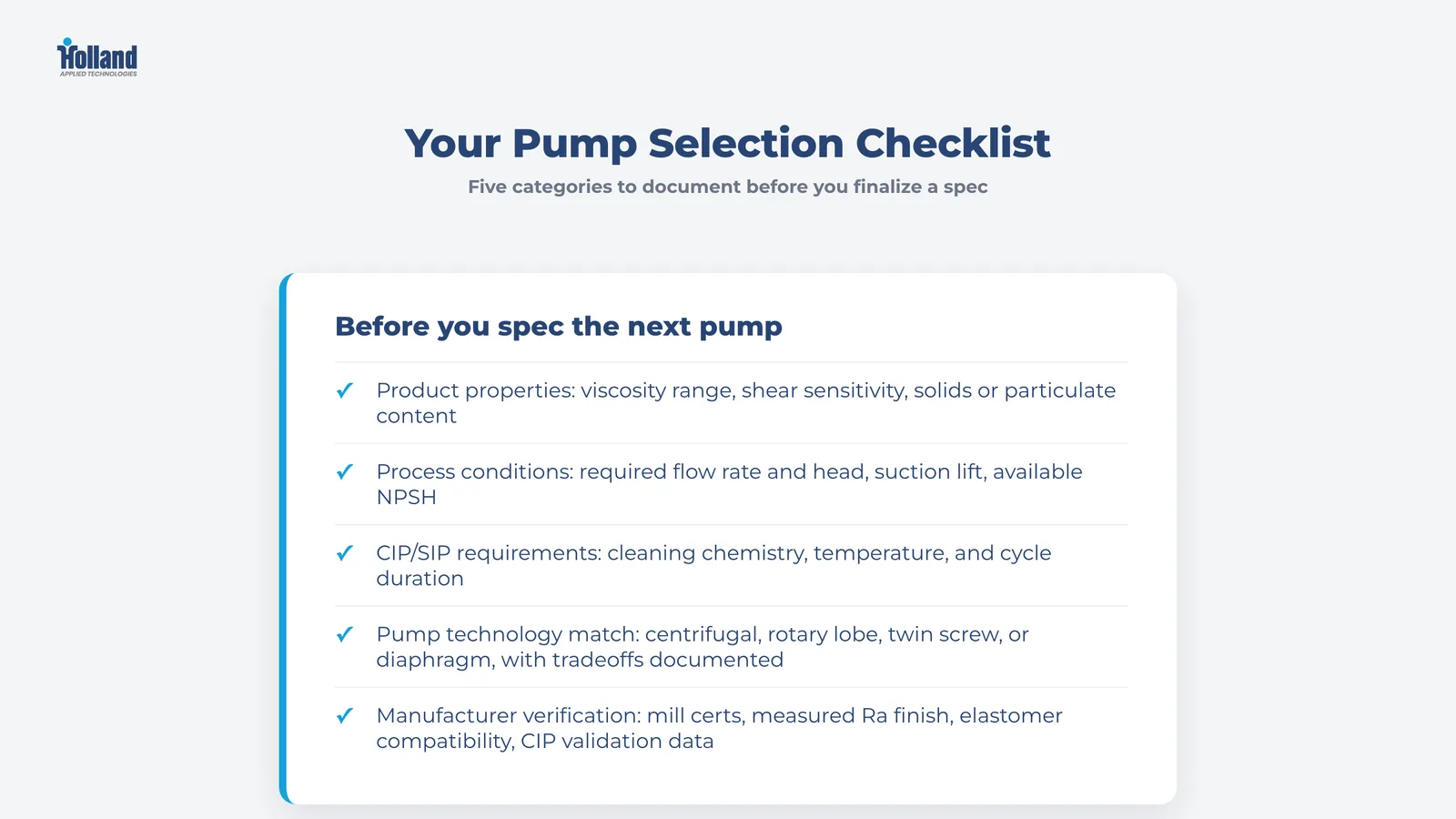
A usable checklist covers five categories in order, and keeping the completed version on file documents the decision for the next time this line’s requirements change:
- Product properties: measured viscosity at minimum, typical, and maximum operating temperature; shear sensitivity assessment; solids or particulate size, hardness, and concentration.
- Process conditions: required flow rate and head at the real operating point; suction lift, pipe run, and available NPSH.
- CIP/SIP requirements: cleaning chemistry, temperature, and cycle duration; any regulatory or internal cleanability validation standard.
- Pump technology match: confirmed selection among centrifugal, rotary lobe, twin screw, or diaphragm, with the tradeoffs documented alongside the choice.
- Manufacturer verification: mill certs on wetted materials, measured Ra finish spec, seal elastomer compatibility for your specific CIP chemistry, and CIP validation data for the exact model.
Turn the framework into your next spec
Choosing the right sanitary pump for a food processing application comes down to matching your product’s properties, your process conditions, and your CIP/SIP requirements to a pump technology built for that combination, then verifying the specific model against real data: mill certs, measured Ra, elastomer compatibility, and CIP validation. The checklist above turns that matching exercise into something repeatable, so the next pump spec for this line starts from your actual numbers already on file.
Ready to solve this?
Bring Holland’s engineers your product and process data and get a pump recommendation.